
Thai Organizations Still Test on a Schedule While Attackers Hunt Every Second
What Is Continuous Threat Exposure Management, and Why CTEM Matters in 2026
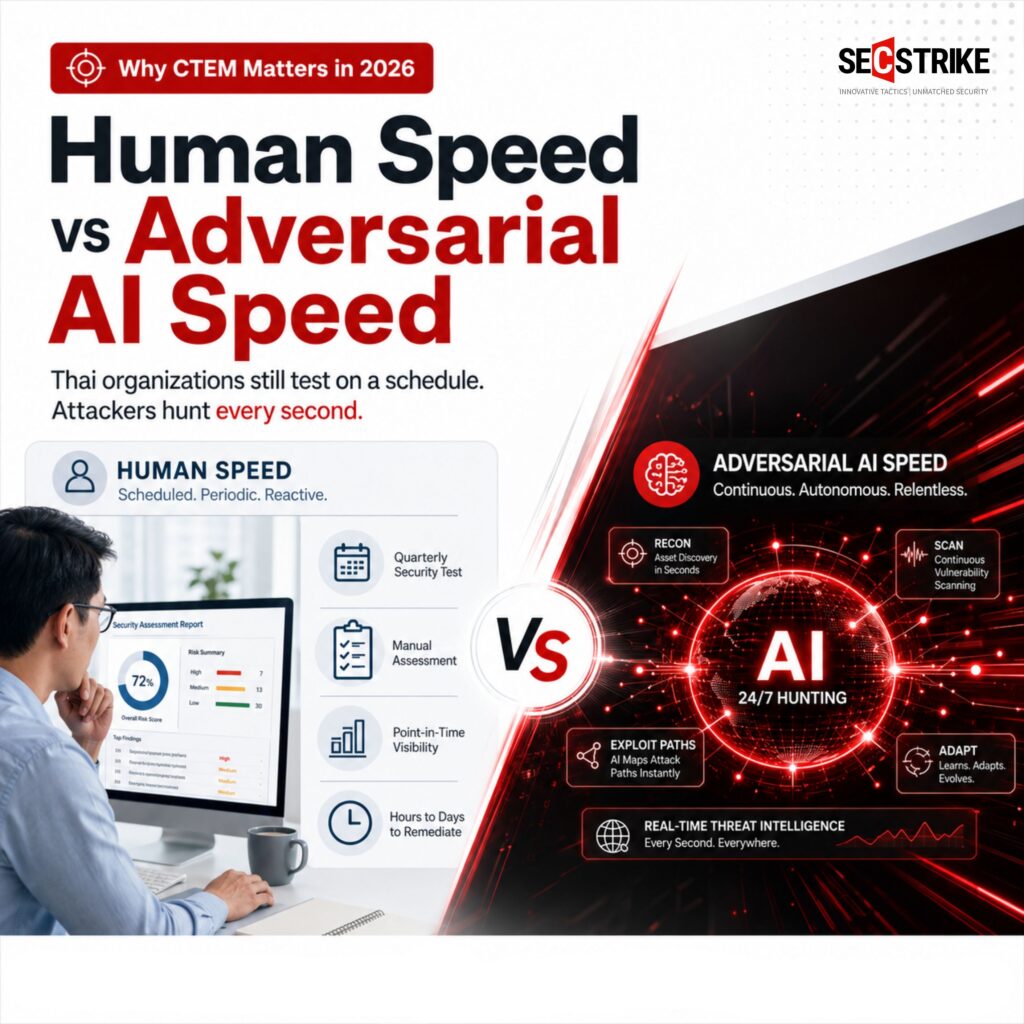
Many Thai organizations still test cybersecurity on a schedule.
Annually.
Quarterly.
Before an audit.
After an incident.
Attackers do not wait for your scan cycle.
In 2026, cybercriminals use underground AI tools such as WormGPT, FraudGPT, rogue LLMs, and autonomous AI-reconnaissance agents to accelerate target discovery, phishing, social engineering, malware workflows, and vulnerability hunting 24/7.
That is the gap.
Organizations test at human speed.
Attackers hunt at adversarial AI speed.
Traditional Vulnerability Management is no longer enough because it gives a snapshot of the past.
But your environment changes daily.
A new zero-day appears.
An engineer makes a configuration mistake.
A development team launches a test API.
A vendor receives too much access.
A cloud storage bucket is set to the wrong permission level.
A PDF report that looks complete today may be outdated tomorrow.
Executives should not only ask: “What vulnerabilities do we have?”
They should ask:
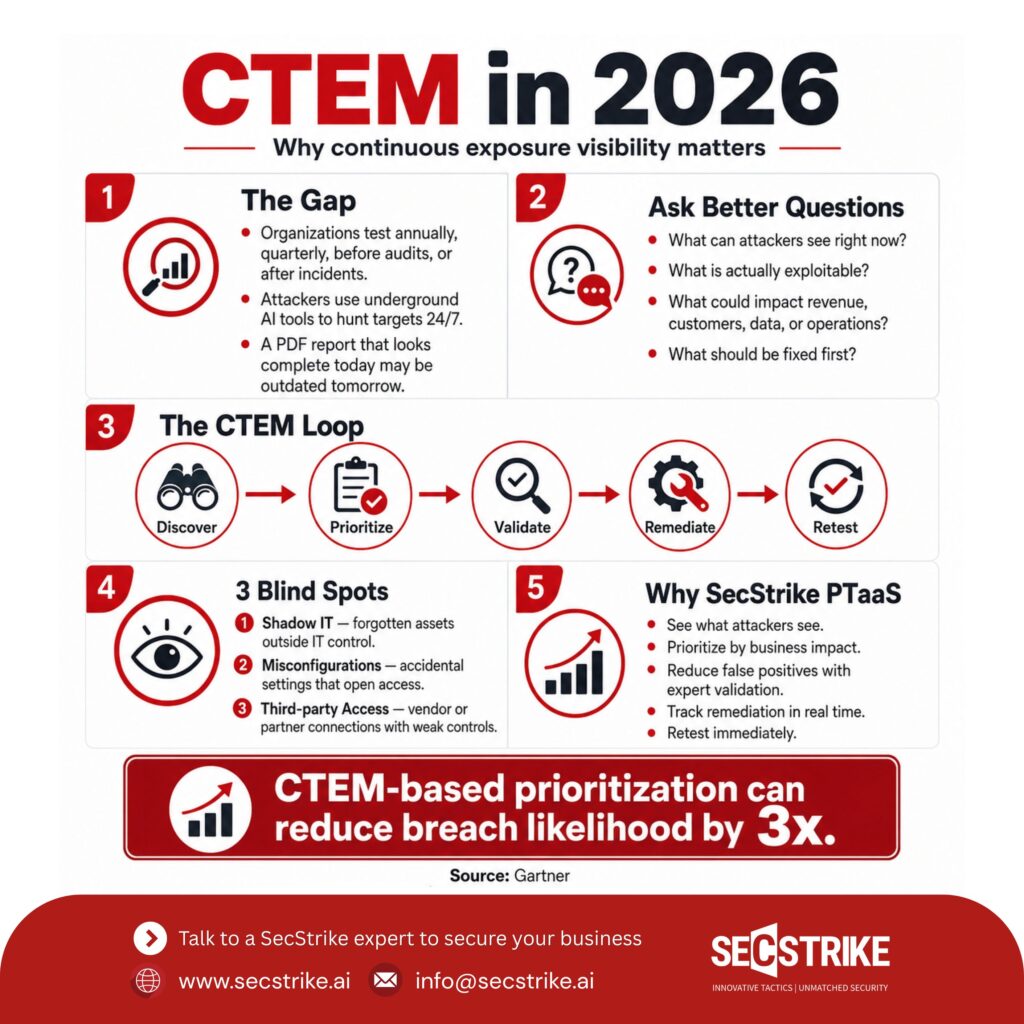
What can attackers see right now?
What can actually be exploited?
What could impact revenue, customers, data, or operations?
What should be fixed first?
What Is Continuous Threat Exposure Management?
Continuous Threat Exposure Management, or CTEM, is a continuous cybersecurity risk management approach that helps organizations discover, prioritize, validate, reduce, and retest real exposure.
CTEM is not just another scan.
It is a continuous loop:
Discover → Prioritize → Validate → Remediate → Retest
This is the core difference in Vulnerability Management vs CTEM.
Traditional Vulnerability Management asks:
“What vulnerabilities did we find?”
CTEM asks:
“Which exposures are live, exploitable, business-critical, and urgent?”
Gartner has predicted that organizations prioritizing security investments through a CTEM program are three times less likely to suffer a breach.
For CEOs, CFOs, CISOs, and IT Directors, this is not just a technical issue.
It is business risk.
3 Blind Spots Attackers Often See First
1. Shadow IT
Shadow IT means systems, websites, APIs, or cloud services created by employees or teams for temporary use, then left outside IT control.
Examples include test websites, demo portals, unmonitored test APIs, old subdomains, and forgotten cloud storage buckets.
Business impact:
These assets often have no monitoring, no patching, no MFA, and no clear owner.
Your organization may not know they are still online.
Attackers can still find them.
2. Misconfigurations
Misconfigurations are accidental system settings that make it easier for attackers to access systems, data, or privileges.
Examples include former employee access left active, excessive admin privileges, firewall rules disabled and never restored, overly broad cloud permissions, or weak Active Directory policies.
Business impact:
One misconfiguration can allow attackers to access customer data, escalate privileges, or move from one system to another.
This risk is usually caused by speed and complexity, not bad intent.
3. Third-party Access
Third-party Access means the connections your business gives to vendors, suppliers, SaaS platforms, outsourced IT providers, and business partners.
These connections are necessary.
But they also create exposure you do not fully control.
Examples include vendor accounts without MFA, shared API keys, weak supplier portals, or third parties with excessive access.
Business impact:
Your internal systems may be secure.
A weaker vendor connection can still become the bridge into your environment.
Third-party risk is not only a procurement issue.
It is board-level cyber risk.
The SecStrike Answer: PTaaS That Gives Visibility, Not Just PDFs
SecStrike helps Thai organizations move from static security testing to dynamic exposure visibility.
We do not believe a 500-page PDF report is enough.
It may be obsolete as soon as the environment changes.
SecStrike combines elite human pentesters with a real-time PTaaS Dashboard so your team can see important risks, track remediation, and request retesting the moment a bug is fixed.
This is the value of Penetration Testing as a Service and PTaaS in Thailand.
SecStrike helps you:
See what attackers see
Identify meaningful exposure, not just long vulnerability lists.
Know what to fix first
Prioritize by business impact, not only technical severity.
Reduce false positives
Use expert validation instead of raw scanner output.
Track remediation in real time
View status, severity, ownership, and progress through the dashboard.
Retest immediately
Confirm fixes without waiting for the next pentest cycle.
Conclusion: In 2026, Risk Visibility Must Be Continuous
Annual or quarterly scanning is no longer enough.
Not because scanning has no value.
Because threats now move faster.
When attackers use AI to hunt targets 24/7, organizations cannot manage cyber risk with historical data.
CTEM helps you see current exposure.
SecStrike PTaaS helps you test, prioritize, remediate, and retest faster.
See what attackers see before they use it against your business.
Request Free Consultation
www.secstrike.ai
info@secstrike.ai
Sources
- Gartner Strategic Roadmap for Continuous Threat Exposure Management, describing the shift from traditional vulnerability management to dynamic exposure management.
- Gartner CTEM framework and widely cited prediction that organizations using CTEM-based prioritization are 3x less likely to suffer a breach.
- Public reporting on WormGPT, FraudGPT, rogue LLMs, and malicious AI tools being used to accelerate phishing, malware workflows, target discovery, and cybercrime operations.
- SecStrike Company Profile 2026: Human + Platform + AI model, PTaaS/PTX Dashboard, real-time tracking, and retest workflow.
- SecStrike Thai Key Messaging Guide: vulnerability discovery positioning, Thai messaging tone, CTA language, and terminology guidance.