
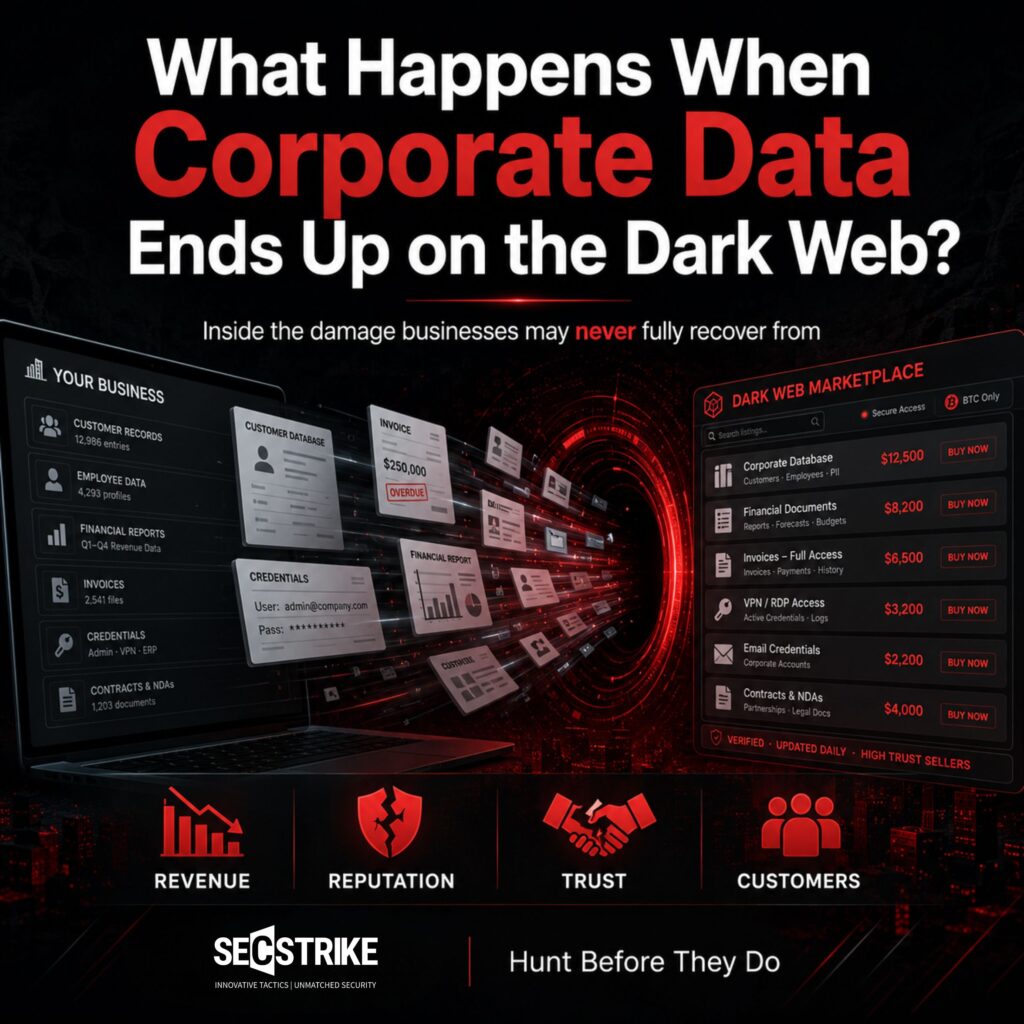
Inside the Damage Businesses May Never Fully Recover From
When company data appears on the Dark Web, many people think it is an IT issue.
It is not.
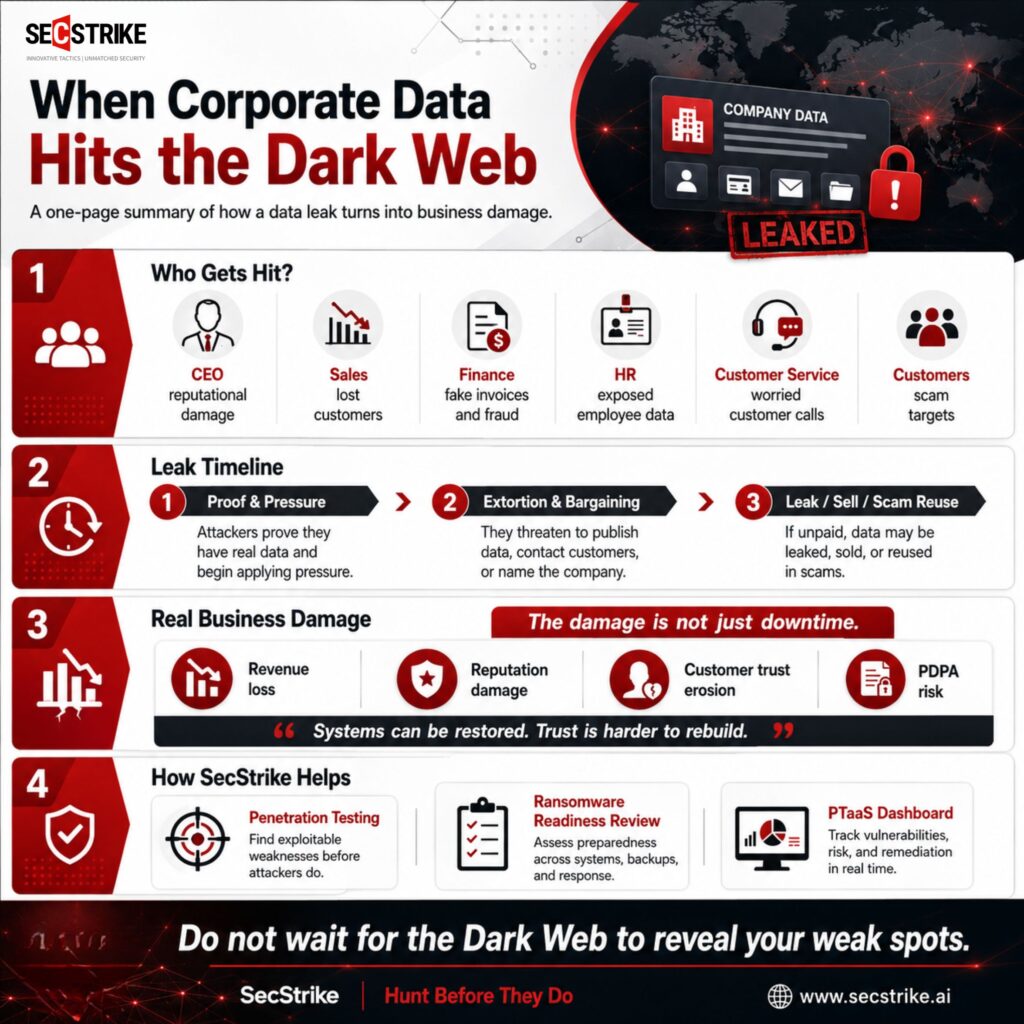
Everyone can be affected.
The CEO faces reputational damage.
Sales may lose customers.
Finance may face fake invoices.
HR may deal with exposed employee data.
Customer service must calm worried customers.
And customers may become scam targets.
A data leak is not just leaked files. It is the beginning of real business damage.
In many modern ransomware cases, attackers do not only lock systems. They steal data first, then use it to pressure the company into paying. This is commonly known as double extortion.
Timeline of a Leak: What Happens After Data Is Stolen
1. Proof & Pressure: Attackers Prove They Have Real Data
After stealing data, attackers first check what they have.
Customer lists
Emails
Invoices
Contracts
Employee data
Passwords
Sensitive business documents
Then they may send a small sample to prove the data is real.
This is where the pressure begins. The company now knows the damage is possible — even before customers, partners, or the public know anything.
2. Extortion & Bargaining: The Company Is Pressured to Pay
Next comes the threat.
“Pay us, or we publish your data.”
“Pay us, or we contact your customers.”
“Pay us, or your company appears on our leak site.”
This is where a data leak becomes a full business crisis.
The company is not only trying to restore systems. It is trying to protect trust, customers, reputation, revenue, and PDPA responsibilities.
Systems can be restored.
Customer trust is harder to rebuild.
3. Leak / Sell / Scam Reuse: The Damage Spreads
If the company does not pay, attackers may try to profit or cause damage another way.
They may leak the data on the Dark Web.
They may sell it to other criminals.
Or they may let scammers reuse it.
At this stage, the damage spreads fast.
Customer data can be used for scam calls.
Employee emails can be used for fake messages.
Financial details can be used for fake invoices.
Internal documents can be used to impersonate executives.
The more real information scammers have, the more believable the scam becomes.
This is when a data leak stops being an IT problem and becomes everyone’s problem.
PDPA: Data Security Is a Business Responsibility
For Thai organisations, a data leak is not only a reputation issue.
PDPA Section 37 sets duties for data controllers, including appropriate security measures and actions related to personal data breach incidents under applicable rules.
In simple terms, businesses must be able to show that they are protecting, testing, and improving their security.
Waiting until after an incident to find weaknesses may be too late.
How SecStrike Helps Stop the Damage Before It Starts
SecStrike helps organisations find weaknesses before attackers do.
Penetration Testing simulates a real attack to show what an attacker could access and which weaknesses should be fixed first.
Ransomware Readiness Reviews show how prepared the business is if ransomware hits today — from critical systems and backups to communication and executive decision-making.
PTaaS Dashboard gives real-time visibility into vulnerabilities, risk levels, remediation status, and retesting progress.
Because a small weakness today can become tomorrow’s headline.
A Dark Web leak does not only affect systems.
It affects people, revenue, reputation, trust, and customers.
Do not wait for the Dark Web to reveal your weak spots.
SecStrike: We find your vulnerabilities before someone else does.
Hunt Before They Do
Sources
- CISA StopRansomware Guide: https://www.cisa.gov/stopransomware/ransomware-guide
- Thailand PDPA Section 37 summary: https://pdpathailand.com/pdpa/content_eng/article37_eng.php
- SecStrike Thai Key Messaging Guide 2026
- SecStrike Company Profile 2026