

Has Your Organization Closed Last Month’s Microsoft Vulnerabilities?
Tomorrow is Microsoft Patch Tuesday for July 2026.
For many organizations, that simply means preparing for another round of Windows updates. But for IT Managers, CISOs, CTOs, and business leaders, it should trigger a more important question
Have we fully closed the vulnerabilities from June Patch Tuesday?
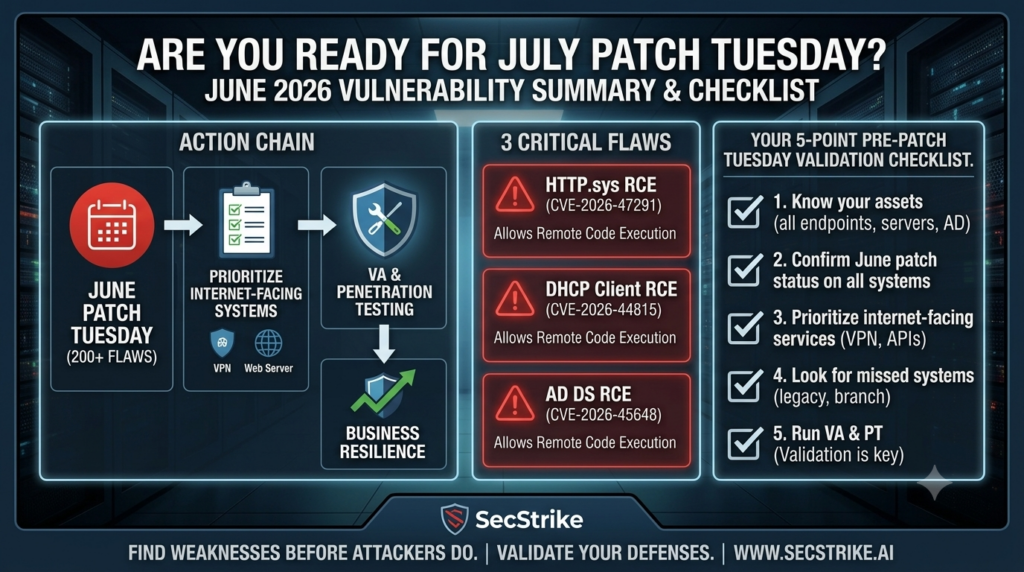
June was not a small update. Microsoft fixed more than 200 vulnerabilities, including multiple Critical issues affecting important systems such as Windows Server, HTTP.sys, DHCP Client Service, and Active Directory.
In cybersecurity, an unpatched vulnerability is not just unfinished IT work.
It can become the first door an attacker uses to enter your organization.
Patch Tuesday Is Not Just About Clicking “Update”
Patch Tuesday is Microsoft’s monthly security update cycle. It addresses vulnerabilities across products many businesses use every day, including Windows, Microsoft Server, Office, Azure, and Active Directory.
For individual users, automatic updates may be enough in many cases. For organizations, patching is more complicated.
A real business environment includes employee laptops, Windows Server systems, Domain Controllers, VPNs, web applications, cloud workloads, branch office devices, and legacy systems that may not be easy to update.
The common problem is simple:
An organization believes it is patched — until a Vulnerability Assessment or Penetration Testing engagement reveals forgotten servers, unmanaged endpoints, or network segments that were missed.
That is why patching alone is not enough.
Organizations need to validate that critical vulnerabilities are no longer present in the real environment.
3 June Vulnerabilities That Should Be a Warning Sign
Below are three Critical vulnerabilities from Microsoft’s June 2026 Patch Tuesday that organizations should validate before the next update cycle begins.
1. CVE-2026-47291 — Windows HTTP.sys Remote Code Execution
This vulnerability affects HTTP.sys, a Windows component used to process HTTP traffic for certain Windows Server services.
The risk is serious. If an affected system remains unpatched, an attacker may be able to achieve Remote Code Execution (RCE) and use the server as an entry point into the environment.
In plain terms: if the server is reachable over the network and still vulnerable, it may give attackers a way in.
Who should pay attention?
Organizations running Windows Server, web services, API services, or HTTP/HTTPS services exposed internally or externally.
2. CVE-2026-44815 — DHCP Client Service Remote Code Execution
DHCP Client Service helps devices receive IP addresses and network configuration automatically.
Because DHCP is a basic network service, many organizations may not think of it as a major attack surface. But if a Critical vulnerability exists and remains unpatched, it can become part of an attacker’s chain to move deeper into the network.
This vulnerability is a reminder that attack surfaces are not limited to VPNs, firewalls, and web applications.
Basic network services can also create serious risk.
Who should pay attention?
Organizations with many Windows endpoints, branch offices, multiple VLANs, internal Wi-Fi, or devices that are not patched consistently.
3. CVE-2026-45648 — Active Directory Domain Services Remote Code Execution
Active Directory is the backbone of identity and access control in many Windows-based organizations. It manages user accounts, access permissions, and security policies.
If Active Directory is affected by a serious vulnerability, the impact can be much larger than a single compromised machine. Attackers may use it to escalate privileges, move laterally, or prepare for ransomware deployment.
For business leaders, think of Active Directory as the master key to the building.
If that key is compromised, attackers may not stop at one room.
Who should pay attention?
Organizations using Domain Controllers, connecting Active Directory to Microsoft 365, VPNs, file servers, or internal systems, especially if they have not recently performed an Active Directory security review.
Why This Matters for Thai Businesses
Cyberattacks do not always begin with a dramatic breach.
They often begin with something small: an unpatched server, a stolen account, an exposed VPN, or a branch office device no one has checked.
Once attackers get in, the impact is no longer just technical. It becomes a business issue:
- Systems can go offline
- Customer data may be exposed
- Employees may be unable to work
- Customer trust can be damaged
- Ransomware risk increases
So before the next Patch Tuesday arrives, the real question is not only:
“Have we updated?”
The better question is:
“Have we validated that our critical vulnerabilities are actually closed?”
A Short Checklist Before the Next Patch Tuesday
Before the new update cycle begins, IT and security teams should check five things:
- Know your assets
Include endpoints, servers, Domain Controllers, cloud workloads, and branch office systems. - Confirm June patch status
Do not rely only on policy. Check whether systems were actually updated. - Prioritize internet-facing systems
Start with VPNs, web servers, APIs, and remote access systems. - Look for missed systems
Pay attention to legacy systems, branch office devices, and vendor-managed systems. - Run Vulnerability Assessment or Penetration Testing
Validate that vulnerabilities are closed and understand how far an attacker could go if one is exploited.
How SecStrike Can Help
SecStrike helps Thai organizations find weaknesses before attackers do through:
- Vulnerability Assessment — identify vulnerabilities and prioritize risk
- Penetration Testing — test systems from an attacker’s perspective
- Security Configuration Assessment — find risky settings and weak configurations
- Ransomware Readiness Review — assess readiness before an incident happens
We do not just tell you what vulnerabilities exist.
We help you understand which vulnerabilities matter most to your business and what to fix first.
Conclusion: Don’t Wait for New Vulnerabilities If Old Ones Are Still Open
The next Patch Tuesday is coming.
But your organization’s real risk may still be hiding in vulnerabilities from the last cycle.
Before the next update adds more work to your IT team, now is the right time to validate whether your critical systems are actually secure.
SecStrike helps you find weaknesses before attackers do.
Request a free, no-obligation consultation today.
Website: www.secstrike.ai
Email: info@secstrike.ai
Sources
- Microsoft Security Update Guide FAQ — Patch Tuesday release schedule.
https://www.microsoft.com/en-us/msrc/faqs-security-update-guide - Microsoft Learn — Windows update release cycle.
https://learn.microsoft.com/en-us/windows/deployment/update/release-cycle - BleepingComputer — Microsoft June 2026 Patch Tuesday fixes 6 zero-days, 200 flaws.
https://www.bleepingcomputer.com/news/microsoft/microsoft-june-2026-patch-tuesday-fixes-6-zero-days-200-flaws/ - Qualys — Microsoft and Adobe Patch Tuesday, June 2026 Security Update Review.
https://blog.qualys.com/vulnerabilities-threat-research/2026/06/09/microsoft-and-adobe-patch-tuesday-june-2026-security-update-review - SecStrike Thai Key Messaging Guide 2026.
- SecStrike Company Profile 2026.