
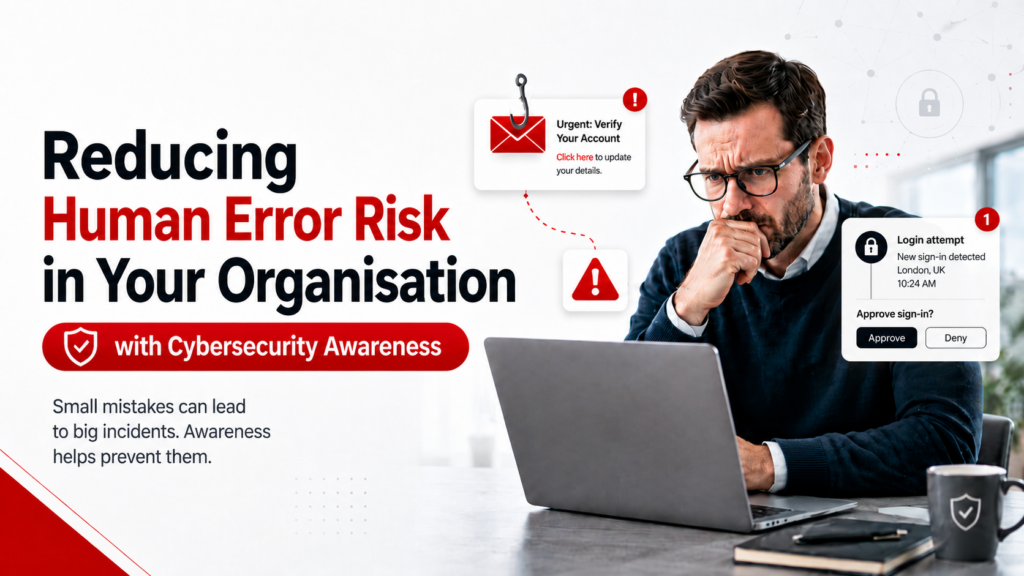
Robust cybersecurity can be brought down by just a single person.
Cybersecurity awareness is far more critical than often realized. Reports indicate that over 95% of cybersecurity incidents stem from human error rather than the complex technical attacks commonly imagined. This clearly demonstrates that no matter how robust a system’s design may be, a hidden vulnerability remains: the human element. Consequently, modern organizations must prioritize workforce development alongside technological advancements, fostering cybersecurity awareness to transform employees from a potential weakness into the organization’s first line of defense.
In this article, SOSECURE—an expert in cybersecurity and a provider of penetration testing services—delves into the importance of cybersecurity awareness, explores why the human element represents the most critical vulnerability in security systems, and discusses how organizations can effectively mitigate threat-related risks.
The Importance of Cybersecurity Awareness for Organizations in the Cyber Era
Cybersecurity awareness is about enabling employees to recognize risks and make safe decisions in all digital activities. The importance of cybersecurity awareness lies in its significant role in mitigating human error in cybersecurity, a major cause of data breaches worldwide. It’s also a key requirement of security standards like ISO 27001, which mandates organizations provide evidence of continuous training and awareness campaigns for their employees. Even with advanced technology, if employees don’t understand how to use it safely, data breaches and organizational damage remain possible.
Why are humans the biggest weak point in organizational security systems?
Even though many organizations invest in advanced technology, the most difficult thing to control remains “human behavior.” Human error in cybersecurity doesn’t stem from faulty systems, but from the decisions, perceptions, and interactions of people within the organization—collectively known as “Human Cyber Risk.” The worrying point is that these risks are unpredictable and can occur in any context, whether using systems, the internet, communicating, or even talking on the phone. This makes “people” the most frequently and easily vulnerable to attacks. Below is the answer to the question of why humans are the most significant weakness in cybersecurity.
- Human behavior is more difficult to control than systems: Systems can be configured and policies set, but human behavior changes according to circumstances, creating unpredictable risks.
- Work habits lead to carelessness: Doing repetitive tasks every day causes employees to let their guard down and overlook small details that could be signs of risk.
- Decision making under haste or pressure: In situations where a decision must be made quickly Humans have the opportunity to choose the path that is “convenient” rather than “safe”.
- Cybersecurity awareness levels vary from person to person: Each employee has a different level of understanding of security, leading to inconsistent security standards within an organization.
- Humans have different “unique weaknesses”: some may be too trusting, while others may be less cautious, creating vulnerabilities that can be easily exploited for risky situations.
What are some common forms of human error in cybersecurity?
Now that we understand why humans are the most significant weak point in security systems, the next question is, in what forms do these errors occur? In this section, SOSECURE, as a cybersecurity expert, will share some examples of common human error in cybersecurity within organizations. Let’s take a look.
- Clicking on a phishing link from a fake email: One unintentional click can give hackers access to your account information or organizational systems.
- Downloading dangerous attachments: Opening files from untrusted sources can lead to the unwitting installation of malware, which can be the starting point of a system-level attack.
- Using unsecured personal devices: Devices that are not updated, do not have antivirus software, or do not have security settings configured can become vulnerabilities for accessing organizational data.
- Sharing company information through insecure channels, such as sending information to the wrong email address, using unauthorized platforms, or without encryption, can lead to the leakage of sensitive data.
- Neglecting basic security measures: such as not enabling MFA, ignoring security alerts, or postponing system updates.
This demonstrates that human error in cybersecurity doesn’t stem from a single major incident, but rather from recurring small behaviors on a daily basis. If organizations don’t seriously build a foundation of cybersecurity awareness, these risks will continue to accumulate and potentially become major problems in the future.
One click and it's over! How to protect company employees from phishing.
Phishing is considered a common human error in cybersecurity, where malicious actors impersonate trustworthy entities such as banks, government organizations, or even internal personnel to trick employees into clicking links, visiting fake websites, or entering sensitive information. To reduce the risk of falling victim to this type of threat, SOSECURE recommends the following simple ways for company employees to protect themselves from phishing
- Do not give out personal or account information without verifying the source: If the contact was not initiated by you, you should not provide any sensitive information, whether via email, website, or phone.
- Always verify the sender’s credibility: Even if an email appears to come from a familiar organization, carefully check the email domain and URL, as it may be a fake.
- Avoid clicking links or pressing buttons directly from emails: If access is necessary, type the website URL manually or access it only through trusted channels.
- Do not open attachments from unreliable sources: Attachments may contain malware that can gain control of your system or steal your data without your knowledge.
- Use Multi-Factor Authentication (MFA): Add an extra layer of security to your account. Even if your data is compromised, it helps prevent unauthorized access.
- Regularly monitor your account activity and information: Checking for anomalies, such as unfamiliar usage or incorrect transactions, will help you address them more quickly.
- Update your system and software to the latest version: To close vulnerabilities that could be exploited as a gateway for attacks.
- Notify your IT or Security team immediately when you discover anything unusual: The sooner you report it, the more damage can be minimized, and the more timely the organization can respond.
Strengthen your organization with Human-Centered Security and reduce Human Error.
Human-Centered Security is a design concept for security systems, policies, and processes that prioritizes “humans” as the central focus. It doesn’t view employees as a weakness, but rather as a crucial part of defense that requires understanding the real-world work context, including their thought processes, decision-making, and daily limitations. This makes security something that is “achievable,” not just something that “should be done.”
This concept helps transform Cybersecurity Awareness from mere knowledge into a sustainable and real behavior within organizations. Organizations can begin building Human-Centered Security through the following approaches.
Conduct cybersecurity awareness training that is linked to the real-world behavior of employees.
Effective training isn’t just about delivering information or theories; it’s about enabling employees to “understand within their own context.” For example, the finance department should be aware of invoice fraud, and management should be wary of impersonation. Role-based training helps employees visualize and apply the knowledge more effectively.
Perform phishing simulation and scenario-based training.
Simulating attack scenarios, such as phishing email tests, allows employees to learn from firsthand experience and enables the accurate measurement of the organization’s risk behavior, leading to targeted improvements in training plans.
Design a security policy that is “practical”.
Overly strict policies often lead to workarounds, such as writing down passwords or using unauthorized tools (shadow IT). Therefore, a balance should be struck between security and ease of use.
Use Behavior Design principles to encourage safe behavior.
Instead of coercion, use “nudges” or small reminders at crucial moments, such as notifying them before sharing external files or suggesting they enable MFA. These help employees make secure decisions without overthinking.
Building a security culture at the organizational level.
Human-centered security cannot succeed without support from management. Organizations should clearly communicate that cybersecurity is a shared responsibility and empower employees to report mistakes without fear (no-blame culture).
Evaluate, measure, and continuously improve.
Organizations should measure metrics such as phishing click-through rates, reporting behavior of unusual incidents, or the risk level of each department in order to continuously improve strategies, as human behavior and threats are constantly changing.