
Even well-trained employees make mistakes.
They may save passwords in Notepad, use unsafe Wi-Fi, click phishing links, or download free tools hiding malware.
But for CISOs and CEOs, the real issue is not employee blame.
The real issue is whether the organization’s internal infrastructure can contain the damage when a mistake happens.
Security awareness reduces the chance of human error.
Penetration Testing proves whether human error can become a business-wide compromise.
CISA and NSA have identified common enterprise misconfigurations including poor separation of user and administrator privileges, insufficient internal monitoring, lack of network segmentation, weak MFA configuration, poor credential hygiene, and unrestricted code execution. These are system-level weaknesses, not simply employee behavior issues.
1. Password in Notepad: One Leaked Password Should Not Become a Master Key
Saving passwords in plain text is risky. But the bigger risk appears when one exposed credential gives an attacker more access than it should.
In a resilient environment, a normal user account should only have the access required for that person’s role. It should not open unnecessary paths to servers, file shares, databases, administrative tools, or sensitive business systems.
This is the principle of least privilege.
NIST’s Zero Trust guidance emphasizes that trust should not be granted automatically based on network location, while Microsoft’s Active Directory hardening guidance highlights least-privilege administrative models as a way to reduce identity attack surface.
If one password leaks, the attacker’s movement should be limited, visible, and blocked before privilege escalation becomes possible.
2. Unsafe Wi-Fi: External Networks Should Not Become Shortcuts Into the Enterprise
Modern employees work from airports, hotels, cafés, client sites, and public networks. Telling people to avoid unsafe Wi-Fi is useful, but it is not a security architecture.
A resilient enterprise assumes external networks are untrusted.
Critical systems should only be accessible through hardened VPN or Zero Trust access, protected by MFA, device checks, and monitored access policies. Internal services should not be exposed directly to the internet unless there is a clear, controlled business reason.
NIST describes Zero Trust as a shift away from static perimeter-based defense toward continuous verification of users, assets, and resources.
Unsafe Wi-Fi should never become a direct path into internal systems.
3. Phishing Click: One Laptop Should Not Reach Active Directory
Phishing works because humans can be rushed, distracted, or deceived.
But when someone clicks, the damage should not spread from one endpoint to Active Directory, file servers, databases, or core business systems.
In a resilient environment, employee devices are separated from server zones. Endpoint detection is active. Users do not have unnecessary local admin rights. Network access is limited. Suspicious behavior is logged and investigated.
NCSC guidance on lateral movement explains why organizations must stop attackers from moving deeper after gaining an initial foothold.
A phishing click may create an incident.
It should not create a business crisis.
4. Malicious Free Tool: One Download Should Not Open a Backdoor to Core Systems
Employees often download free tools to work faster: PDF converters, file compressors, remote utilities, browser extensions, or productivity apps.
The risk is not only the download. The bigger risk is an environment where unknown software can run freely, connect outward silently, and access internal systems without restriction.
A resilient organization uses application control, EDR, logging, restricted installation rights, and network segmentation to prevent one infected workstation from becoming an attacker’s foothold.
CISA and NSA list unrestricted code execution, weak access control, and insufficient internal monitoring among common misconfigurations that create enterprise risk.
One free tool should not have enough reach to compromise critical systems.
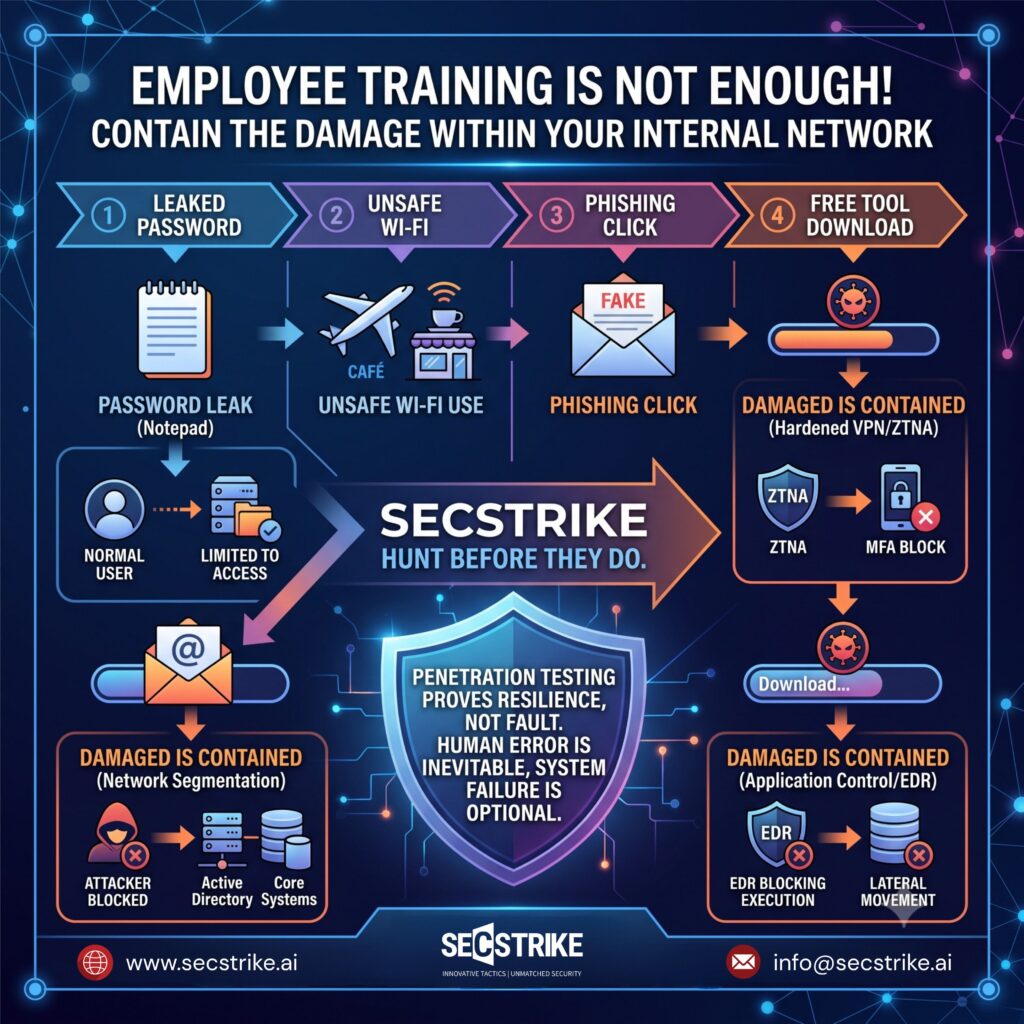
Human Error Is Inevitable. System Failure Must Be Contained.
No organization should build its security strategy on the assumption that every employee will make the right decision every time.
A mature security strategy assumes mistakes will happen and designs systems to absorb them.
That is the difference between awareness and resilience.
Awareness reduces likelihood.
Pentesting validates containment.
SecStrike: We Do Not Test the Employee. We Test the Defense Architecture.
SecStrike’s Penetration Testing is not designed to blame employees.
We simulate an already compromised insider account to prove whether your internal network, Active Directory, VPN, segmentation, privilege control, logging, and detection can stop an attacker from moving deeper.
SecStrike provides Penetration Testing, Vulnerability Assessment, Red Teaming, Security Configuration Assessment, and Compromised Assessment through a model that combines human expertise, platform delivery, and AI-assisted acceleration.
Every finding is tracked through SecStrike’s PTaaS Dashboard, giving executives and technical teams clear visibility into severity, evidence, remediation progress, and retest tracking.
Human error is inevitable.
Business-wide compromise should not come from one mistake.
Request a Free Consultation
Test your internal network resilience with SecStrike.
Website: www.secstrike.ai
Email: info@secstrike.ai
SecStrike — Hunt Before They Do. Protect. Detect. Respond.
Sources
- CISA/NSA: Top Ten Cybersecurity Misconfigurations.
- NIST SP 800-207: Zero Trust Architecture.
- Microsoft Learn: Reducing the Active Directory Attack Surface.
- NCSC: Preventing Lateral Movement.
- SecStrike Thai Key Messaging Guide 2026.
- SecStrike Company Profile 2026.