How Hackers Attack Web Applications and What Organizations Need to Know

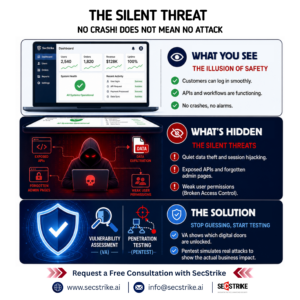
Your web application may look completely normal.

Customers can log in.
APIs are working.
The dashboard loads.
Nothing is crashing.

But here is the uncomfortable truth:

The most dangerous attacks often do not break the system.

Attackers do not always want to be noticed. Many prefer to stay hidden, steal data, hijack sessions, or quietly explore connected systems over time.

So the real question is not only, “Is our application working?”
It is:

“If an attacker looked at our web application today, what would they find?”


Hackers Do Not Use Magic. They Look for Open Doors.

Most web application attacks do not start like a movie scene.

They usually begin with discovery.

Attackers look for what your organization has exposed online, such as:

  • Public APIs 
  • Login portals 
  • Outdated plugins or frameworks 
  • Forgotten admin pages 
  • Old systems still connected to the internet 
  • Forms that do not validate input properly 
  • Weak user permission controls 

In simple terms, attackers walk around your digital building and check which doors are unlocked.


Common Gaps Hackers Use to Get In

1. Broken Access Control: Seeing Data They Should Not See

This happens when an application does not properly check what each user is allowed to access.

For example, User A should only see their own invoice. But by changing an ID in the URL or API request, they can view User B’s invoice.

No password theft.
No dramatic attack.
Just one missing permission check.


2. Injection Attacks: Bad Input Through a Normal Form

A search box, login page, or contact form can become a risk if the application does not handle user input safely.

Instead of typing a normal search term or email address, an attacker may submit malicious input designed to make the system reveal data or behave in an unintended way.

The form is not the problem.
The problem is what the application does with the data it receives.


3. Weak Login and Session Hijacking: Quiet Access Without a Crash

Some attackers do not need to take the system offline.

They try to get in quietly by abusing:

  • Weak passwords 
  • No multi-factor authentication 
  • Long-lived sessions 
  • Poorly protected tokens or cookies 
  • Login pages with weak controls 

Once inside, they may look like a normal user. That makes the attack harder to notice.


The Silent Threat: No Crash Does Not Mean No Attack

Many organizations expect cyberattacks to be obvious.

A website goes down.
A homepage changes.
A system stops working.

But many attackers prefer the opposite.

If the system crashes, your team investigates. If everything looks normal, attackers may have more time to:

  • View customer data 
  • Steal internal records 
  • Use real user accounts 
  • Explore connected systems 
  • Collect information for future attacks 

This is why a working system is not always a secure system.


Closing the Gap: Stop Guessing and Start Testing

Firewalls, antivirus tools, and cloud controls matter.

But they do not fully answer the most important question:

“Can our systems withstand real attack methods?”

That answer comes from testing.

Vulnerability Assessment

A Vulnerability Assessment helps identify weaknesses such as outdated software, misconfigurations, exposed services, and known vulnerabilities.

Penetration Testing

A Penetration Test safely simulates real attack techniques to understand whether those weaknesses can actually be exploited and what the business impact could be.

In simple terms:

VA shows which doors are open.
Pentest shows what could happen if someone walks through them.


Questions Every Organization Should Ask

  • Do we know which web applications and APIs are exposed? 
  • Have our login flows been tested against real attack methods? 
  • Can users access data they should not see? 
  • Are old admin pages or staging systems still online? 
  • Do we know which vulnerabilities should be fixed first? 

If the answer is “we are not sure,” it is time to test.


Conclusion: Find the Gap Before Attackers Do

Hackers do not always need advanced techniques.

Sometimes they only need one exposed API, one weak login flow, one missing permission check, or one forgotten system.

Stronger organizations do not guess.
They test, validate, prioritize, and fix before attackers get the chance.

Request a Free Consultation with SecStrike | Hunt Before They Do.


Sources

  • OWASP Top 10:2021 — Broken Access Control 
  • OWASP API Security Top 10:2023 — Broken Object Level Authorization 
  • OWASP Web Security Testing Guide 
  • Thailand PDPA Section 37 
  • SecStrike Company Profile 2026 
  • SecStrike Thai Key Messaging Guide 2026

Leave a Comment

Your email address will not be published. Required fields are marked *

Scroll to Top