
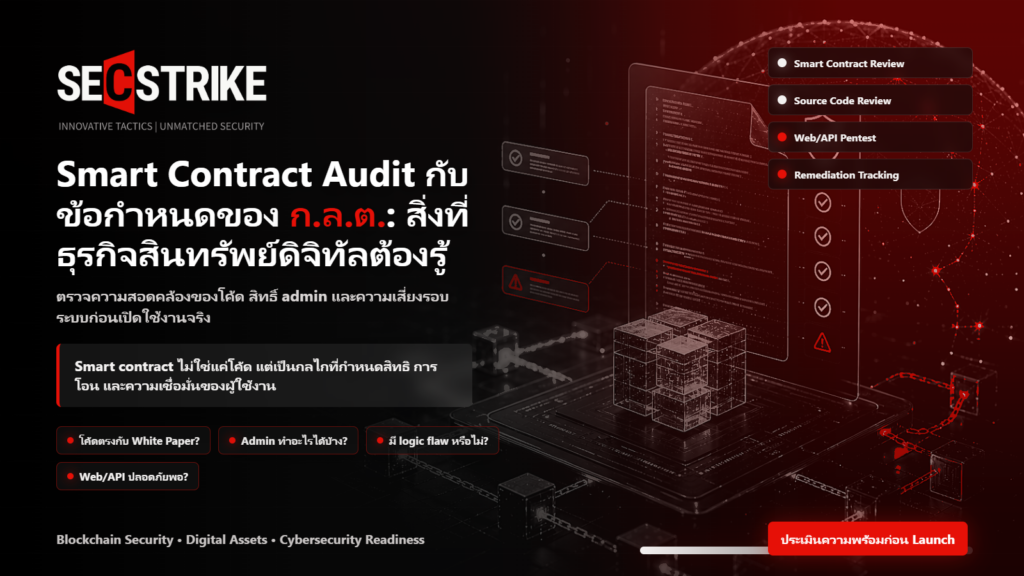
What Digital Asset Businesses Need to Know
A smart contract is not just code. It can define rights, transfers, access, and trust across a digital asset ecosystem.
For digital asset businesses in Thailand, including token issuers, ICO portals, exchanges, brokers, dealers, and blockchain-enabled platforms, smart contract security should not be treated as an afterthought.
If a smart contract fails, the impact may go beyond downtime. It can lead to asset loss, incorrect rights allocation, repeated exploitation, and regulatory or reputational risk.
Why Smart Contract Audit Matters
Smart contracts execute based on conditions written into code.
Once deployed on a blockchain, changes may be difficult, limited, or dependent on the contract design and governance model.
This makes pre-deployment review critical, especially for contracts involving:
- Digital token issuance
- Token holder rights
- Asset transfer or custody logic
- Staking, rewards, vesting, or lock-up mechanisms
- Wallet, bridge, or DeFi integrations
- Admin roles and upgrade functions
Key Areas Digital Asset Businesses Should Review
1. Alignment Between Smart Contract and White Paper
The smart contract should reflect the rights, conditions, and mechanisms described in the offering documents or white paper.
If the code behaves differently from what has been disclosed, the project may face user, investor, and regulatory trust issues.
2. Access Control and Admin Privileges
Review who can mint, burn, pause, upgrade, withdraw, or change core contract parameters.
Overly broad admin privileges can become a major risk in digital asset environments.
3. Logic Flaws and Business Logic Risk
Smart contract issues are not always technical bugs.
They may come from incorrect business logic, such as wrong reward calculation, flawed vesting, duplicate claims, or unintended privilege escalation.
4. Known Vulnerabilities
A strong audit should check for common smart contract risks, including reentrancy, oracle manipulation, signature replay, improper input validation, front-running exposure, and unsafe upgrade patterns.
5. Integration Risk
Smart contracts rarely operate alone.
They often connect with web applications, APIs, wallets, oracles, exchanges, and backend systems. Even if the contract is reviewed, attackers may still exploit weak surrounding systems.
How SecStrike Helps
SecStrike helps digital asset businesses assess risk end to end, not only at the smart contract layer.
Relevant services include:
- Smart Contract Security Review
- Source Code Review
- Web Application Penetration Testing
- API Penetration Testing
- Vulnerability Assessment
- Security Configuration Assessment
- Retesting and Remediation Tracking
SecStrike combines Human Expertise, AI Assistance, and Platform Workflow to help organisations identify vulnerabilities, prioritise real risk, and track remediation clearly.
Final Thought
For digital asset businesses, Smart Contract Audit should not be treated as a final checkbox before launch.
It should be part of a broader security lifecycle covering tokenomics design, code review, API security, privilege management, deployment readiness, and retesting after remediation.
Preparing to issue a token, deploy a smart contract, or operate a digital asset platform?
Talk to SecStrike to assess your Smart Contract Security, Web/API Pentest readiness, and broader cybersecurity posture before going live.