
What Is the Difference Between Pentest and VA Scan?
Confused between Pentest and VA Scan? This guide explains the difference between Penetration Testing and Vulnerability Assessment, when to use each, and how IT teams should choose.
Penetration Testing vs Vulnerability Assessment: What Is the Difference?
If your IT team is starting to look into cybersecurity assessments, one of the first questions you will probably face is:
“Should we do a Pentest or a VA Scan first?”
It is a common question — and an important one.
Many organisations still use Penetration Testing and Vulnerability Assessment as if they mean the same thing. They do not. Both are useful, but they answer different questions.
In simple terms:
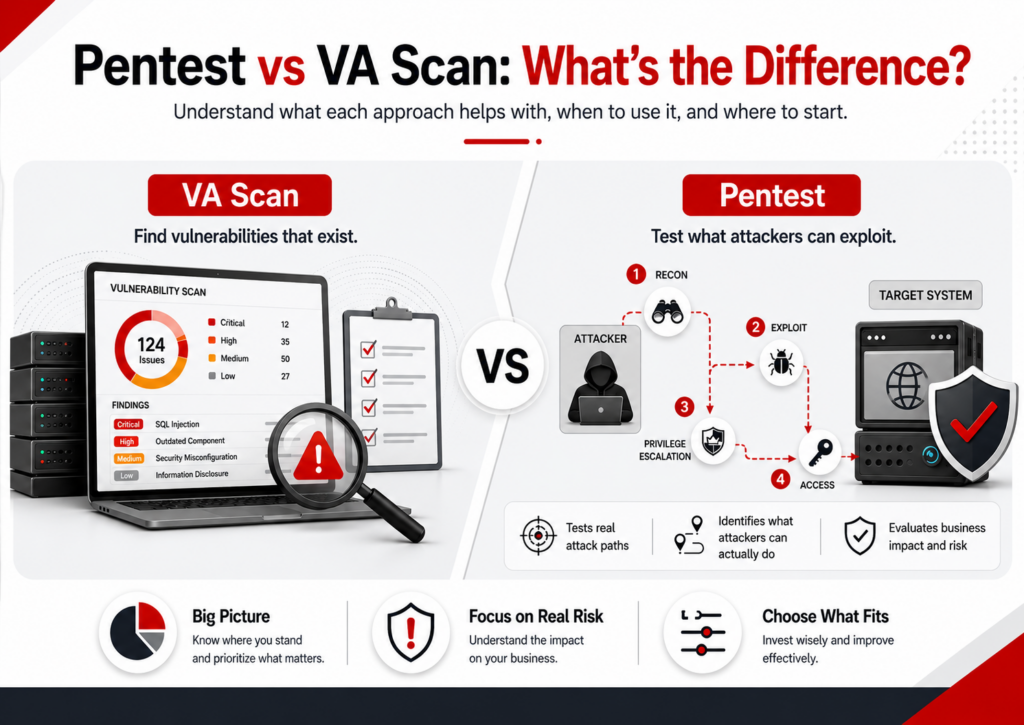
A VA Scan or Vulnerability Assessment helps you find what vulnerabilities exist.
A Pentest or Penetration Test helps you understand what an attacker could actually do with those vulnerabilities.
That difference matters. If you choose the wrong type of assessment, you may still receive a report, but it may not answer the question your organisation actually cares about.
This article explains the difference between Pentest and VA Scan, the benefits of each, common misunderstandings, and when your organisation should use each one.
Why This Article Matters
Most organisations do not start cybersecurity assessments for academic reasons. They start because something triggers the need.
A customer asks for a security report.
An auditor asks about vulnerability management.
Management becomes concerned about ransomware.
A new web application is about to go live.
The IT team simply wants to know where the real risks are.
The problem is that many teams enter the process with unclear expectations.
They run a VA Scan and expect it to prove whether attackers can breach the system.
They run a Pentest and expect it to list every vulnerability across the entire organisation.
They buy a cheap automated scan and assume it is a full penetration test.
They receive a long PDF report but still do not know what to fix first.
A good security assessment should not just produce a document. It should help your team answer a practical question:
“Where are we exposed, and what should we fix first?”
What Is a Vulnerability Assessment or VA Scan?
A Vulnerability Assessment, often called a VA Scan, is a structured process for identifying known vulnerabilities across systems, networks, applications, APIs, cloud assets, or infrastructure.
A VA Scan typically looks for issues such as outdated software, missing patches, exposed services, weak configurations, known CVEs, insecure SSL/TLS settings, default credentials, and common web application weaknesses.
The main question a VA Scan answers is:
“What vulnerabilities do we have?”
A VA Scan is especially useful when you need broad visibility. For example, you may have multiple servers, public IP addresses, websites, cloud assets, or internal systems, and you want to understand your overall exposure.
Common findings from a VA Scan may include:
Finding | What It Means for IT Teams |
|---|---|
Outdated software version | The system may be vulnerable to known public exploits |
Unnecessary open ports | The organisation has a larger attack surface than needed |
Weak SSL/TLS configuration | Data in transit may not be properly protected |
Default or weak credentials | Attackers may gain access with minimal effort |
Web application misconfiguration | Sensitive data or admin functions may be exposed |
The strength of a VA Scan is breadth. It helps you see many potential issues quickly and gives your IT team a starting point for patching, hardening, and prioritisation.
The limitation is that a VA Scan usually identifies the presence of vulnerabilities. It does not always prove whether they are exploitable in your specific environment.
What Is Penetration Testing or Pentest?
Penetration Testing, or Pentest, is a controlled security test performed by experts who simulate real attacker behaviour within an agreed scope.
If a VA Scan tells you where the weak doors and windows might be, a Pentest tests whether those doors can actually be opened — and how far an attacker could go once inside.
A Pentest does not stop at “this vulnerability exists.” It asks deeper questions:
- Can this vulnerability be exploited?
- Can it lead to unauthorised access?
- Can a normal user become an administrator?
- Can the attacker access sensitive data?
- Can multiple low or medium findings be chained into a serious attack path?
- What would the business impact be if this happened in the real world?
The main question a Pentest answers is: “What would happen if someone actually attacked us?”
This makes Pentest valuable for critical systems such as customer-facing web applications, APIs, mobile applications, payment-related systems, internet-facing infrastructure, or platforms that process sensitive business or customer data.
Pentest vs VA Scan: Key Differences
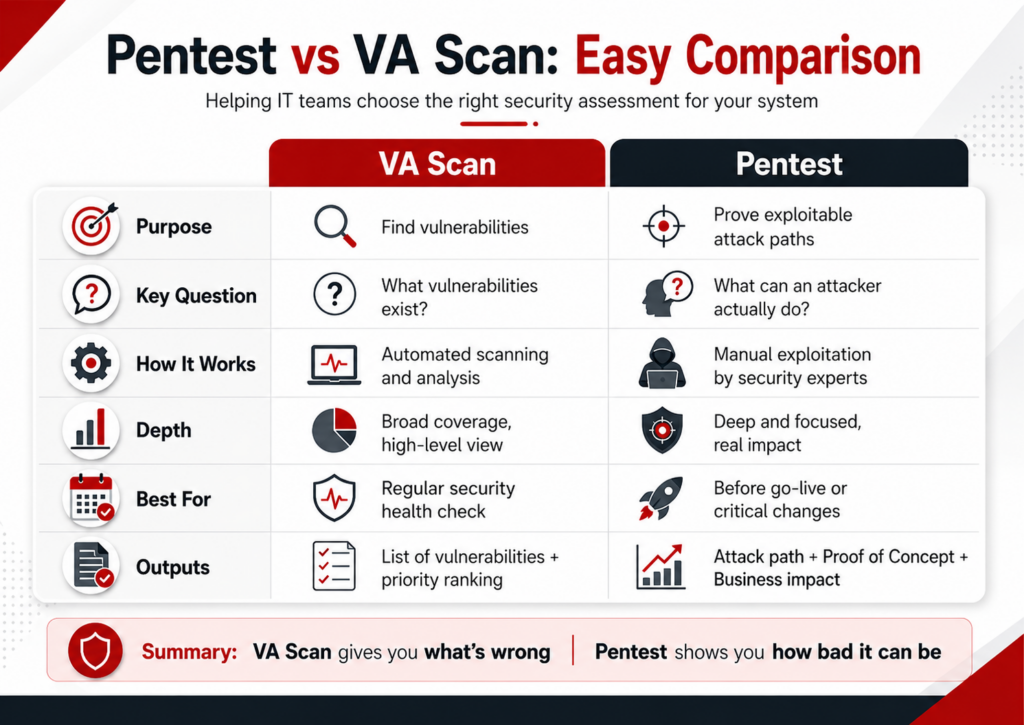
Put simply: A VA Scan helps you see what is wrong.
A Pentest helps you understand how dangerous it is.
Common Misunderstandings
- “If we have done a VA Scan, we have done a Pentest.”
Not necessarily.
A VA Scan is an important part of vulnerability discovery, but a Pentest requires deeper validation, exploitation, and impact analysis.
If the report is mainly a list of tool-generated findings without proof of concept, attack path analysis, or business impact, it may not be a complete penetration test.
- “A Pentest finds every vulnerability in the organisation.”
A Pentest is not unlimited testing across everything. It follows an agreed scope, timeframe, and objective.
For example, the test may cover one web application, a set of APIs, a specific external IP range, or a mobile application. If your goal is to scan a large number of systems for known issues, a VA Scan may be the better starting point.
- “Every Critical finding must always be fixed first.”
Severity matters, but prioritisation should also consider exposure, exploitability, asset importance, compensating controls, and business impact.
A Critical issue on an isolated test system may not be as urgent as a High issue on an internet-facing production system that contains sensitive data.
A good assessment report should help you prioritise, not just categorise.
- “Our environment is small, so we do not need an assessment.”
Many serious incidents start from small weaknesses: an unpatched VPN, a weak password, an exposed admin panel, an overlooked cloud storage setting, or an old service that no one remembers.
Smaller IT teams often have limited time and resources. A well-scoped VA Scan or Pentest helps them focus on the risks that matter most.
When Should You Do a VA Scan?
A VA Scan is a good starting point when:
You want broad visibility across your network or infrastructure
You have many servers, IP addresses, websites, or cloud assets
You have never performed a formal security assessment before
You need a regular security health check
You recently changed firewall, VPN, cloud, server, or network architecture
You want a structured list of patching and hardening actions
A customer, partner, or auditor asks for vulnerability assessment evidence
VA Scan is often the right first step because it gives your IT team a clear view of known weaknesses and helps you build a practical remediation plan.
When Should You Do a Pentest?
A Pentest is more appropriate when:
You are about to launch a critical system
You operate a customer-facing web application, mobile application, or API
The system handles customer data, payment data, or sensitive business data
You recently made a major system change
A VA Scan found serious issues and you need to understand real exploitability
You need a report that explains business impact to management
You want assurance before an audit, launch, or production release
Pentest is most useful when the question is no longer just “what vulnerabilities exist?” but “what could happen if these vulnerabilities were used in a real attack?”
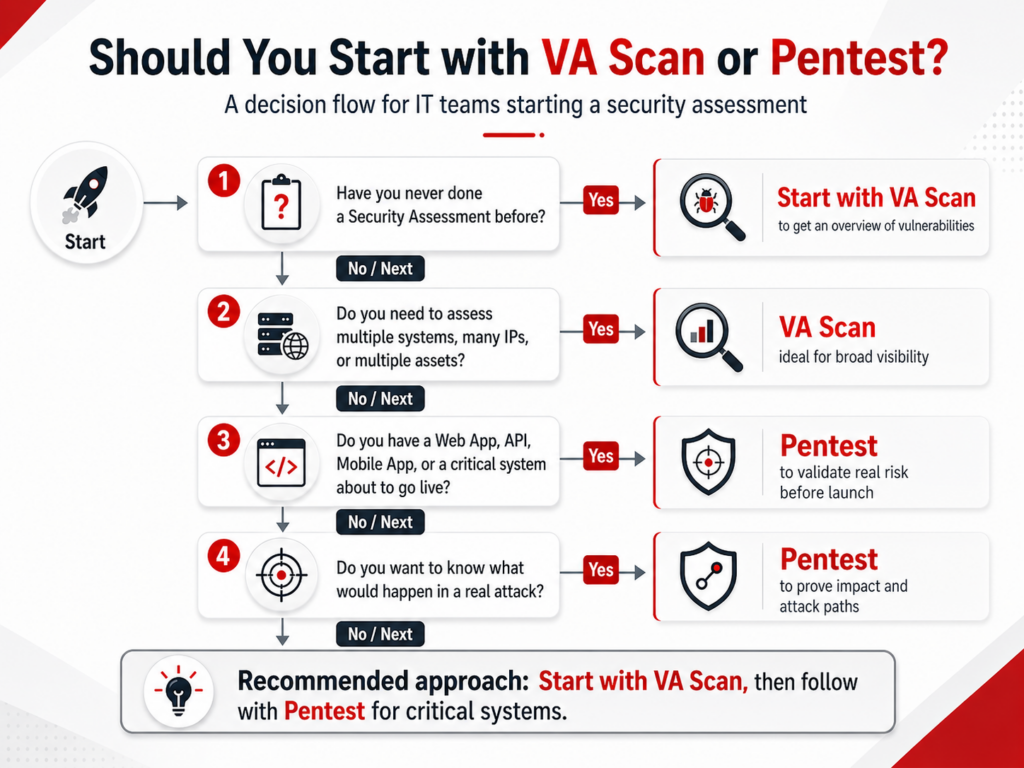
Which Should Come First: VA Scan or Pentest?
For organisations that have never done a security assessment before, a practical approach is:
Start with a VA Scan to understand the overall exposure, then use Pentest to go deeper on critical systems.
For example, a VA Scan may reveal that your organisation has several internet-facing systems, an outdated VPN, and a web application with high-risk findings. Your IT team can then use that information to decide which systems deserve deeper penetration testing.
However, if you are launching a new customer portal, payment system, core API, or application that handles sensitive data, you may choose to start with a Pentest immediately.
The right sequence depends on the question you need answered.
What Should a Good Report Include?
Whether you run a VA Scan or a Pentest, the report should be useful — not just long.
A good report should include:
- Executive summary for management
- Clear vulnerability descriptions
- Severity and risk ratings
- Evidence or proof of concept
- Business impact explanation
- Practical remediation guidance
- Prioritised action plan
- Retest or validation approach after remediation
For Pentest specifically, the report should explain how an attacker could move from initial access to meaningful impact, and what your organisation should do to break that attack path.
Final Takeaway: Pentest and VA Scan Work Best Together
The easiest way to remember the difference is this:
VA Scan identifies and prioritises vulnerabilities.
Pentest validates what those vulnerabilities mean in a real attack scenario.
They are not replacements for each other. They are complementary.
If your question is: “What vulnerabilities do we have?” Start with a VA Scan.
If your question is: “What would happen if someone attacked us?” Run a Pentest.
If your question is: “What should we fix first to reduce real risk?” The best answer often comes from using both in a planned, risk-based way.

Not sure whether your organisation should start with a VA Scan or a Pentest?
Book a short scoping discussion with SecStrike. Our team can help you define the right scope based on your systems, risk level, timeline, and budget.