
Why wait for the final report when your IT team can see vulnerabilities in real time and start fixing them immediately?
Traditional security reporting often works like this:
The assessment is completed.
The report is prepared.
The PDF is delivered.
Then the IT team starts remediation.
For modern IT teams, that process is too slow.
When a Critical or High-risk finding is discovered, the team should not have to wait until the final report to understand the risk, assign ownership, and begin remediation.
That is where real-time vulnerability visibility matters.
What Is Real-Time Vulnerability Visibility?
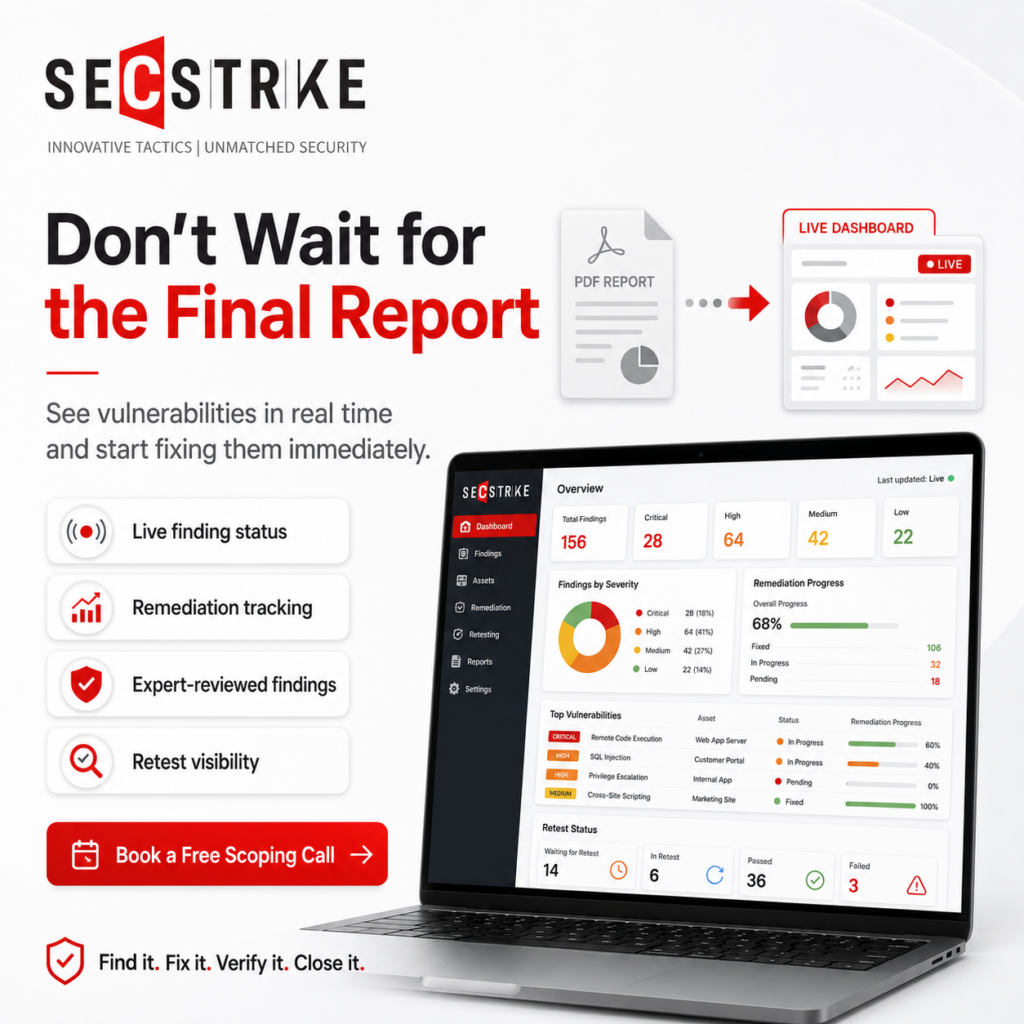
Real-time vulnerability visibility means your team can see the current status of security findings as they are discovered, reviewed, prioritised, remediated, and retested.
Instead of waiting for one static report at the end, IT teams can track:
- Which vulnerabilities have been found
- Which findings are Critical, High, Medium, or Low
- Which findings are still open
- Which issues are being fixed
- Which items need retesting
- Which risks have been confirmed as closed
This gives both technical teams and executives a clearer view of risk throughout the remediation process.
Why Waiting for the Final Report Creates Risk
Static reports are useful for documentation and audit evidence.
But when they are the only source of truth, teams often lose speed and visibility.
Common problems include:
- Critical findings are reviewed too late
- Remediation starts only after the final report
- Status updates are tracked manually
- Findings are scattered across email and spreadsheets
- Teams are unsure which issues have already been fixed
- Retest requests are delayed
- Executives do not see current risk status
A PDF report tells you what was found.
A real-time dashboard helps you understand what still needs action.
What Real-Time Visibility Helps IT Teams Do
Real-time vulnerability visibility helps teams move faster and work more clearly.
1. Prioritise Critical Risks First
Not every vulnerability has the same impact.
Real-time visibility helps teams identify Critical and High-risk findings earlier, so the most important issues can be handled first.
2. Start Remediation Earlier
Teams do not need to wait for the final report before taking action.
If a serious finding is validated, remediation can begin while the assessment is still ongoing.
3. Track Ownership and Progress
Real-time visibility helps teams see which findings are open, in progress, pending retest, or closed.
This reduces confusion and keeps remediation accountable.
4. Improve Executive Visibility
Executives do not need every technical detail.
They need to know overall risk status, remediation progress, and whether the organisation is improving.
A dashboard view helps communicate that clearly.
5. Verify Fixes with Retest Evidence
Fixing a vulnerability is not the same as closing it.
Real-time workflows help teams request retesting and confirm whether the issue has been properly resolved.
How SecStrike Helps
SecStrike helps organisations move beyond static reporting through expert-led testing and platform-based delivery.
With the SecStrike PTX Platform, security findings can be managed through a secure authenticated portal instead of being buried inside PDF attachments, email threads, or spreadsheets.
The platform supports:
- Secure report delivery
- Live finding status
- Severity breakdown
- Remediation tracking
- Expert-reviewed findings
- Retest tracking
- Executive and technical visibility
Every finding is reviewed by experienced security experts to reduce false positives and help teams focus on exploitable risk.
SecStrike supports real-time vulnerability visibility across:
- Vulnerability Assessment
- Penetration Testing
- Web Application Testing
- API Testing
- Security Configuration Assessment
- Retest and remediation workflows
From “Report Delivered” to “Risk Closed”
The goal of security testing is not just to produce a report.
The real goal is to reduce risk.
That means every finding should move through a clear workflow:
Find it.
Review it.
Prioritise it.
Fix it.
Retest it.
Close it with evidence.
Real-time vulnerability visibility helps make that process faster, clearer, and easier to manage.
Final Thought
Modern IT teams should not have to wait until the final report to understand what matters.
If a vulnerability can be seen earlier, it can be fixed earlier.
And if it can be retested and verified faster, the organisation can reduce real risk faster.
Want clearer visibility into your security findings?
Book a free scoping call with SecStrike to discuss Vulnerability Assessment, Penetration Testing, API Testing, and real-time remediation tracking.