
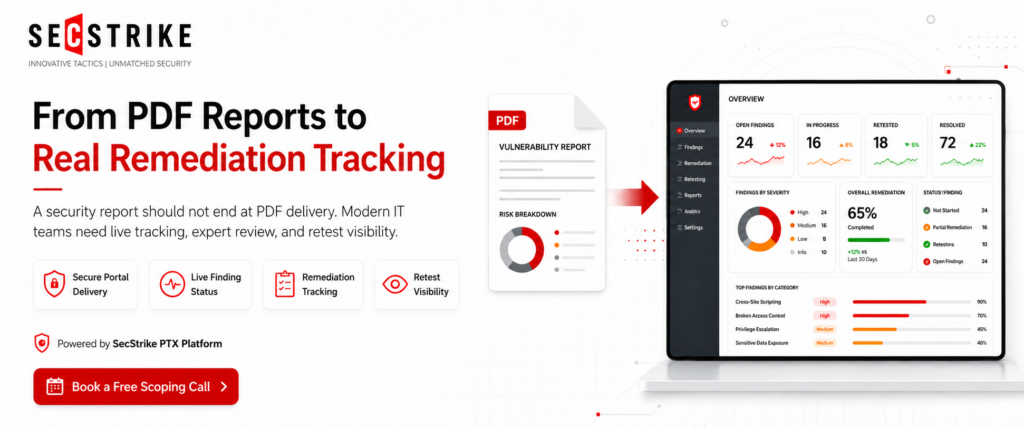
A security report should not end at “PDF delivered.” It should help your team track, fix, retest, and close real risk faster.
For years, security findings from Penetration Testing and Vulnerability Assessment were usually delivered as static PDF reports.
PDF reports still have value. They are useful for audit records, executive summaries, and technical documentation.
But for modern IT teams, a PDF alone is no longer enough.
The real work starts after the report is delivered.
Why Static PDF Reports Are No Longer Enough
Static PDF reports are difficult to manage once remediation begins.
They can tell your team what was found, but they do not easily show:
- Who owns each finding
- Which vulnerabilities are still open
- Which issues have been fixed
- Which findings need retesting
- Whether the overall risk level has changed
- What the executive team needs to see now
When findings are managed across email threads, spreadsheets, chat messages, and PDF files, teams lose visibility.
That slows remediation.
Modern IT Teams Need Live Remediation Tracking
Security reporting should support the full remediation workflow, not only the final report.
A modern approach should help teams:
- View findings in one secure place
- Track status by severity
- Assign ownership
- Monitor remediation progress
- Request retesting
- Confirm closure
- Give executives a clear risk view
This helps security teams move from “we received a report” to “we are actively closing risk.”
What Better Security Reporting Looks Like
A practical reporting workflow should include:
Secure Delivery
Reports and findings should be shared through a secure authenticated portal, not passed around as email attachments.
Real-Time Dashboard
Teams should be able to see open findings, severity breakdown, remediation progress, and retest status in one place.
Expert-Reviewed Findings
Findings should be validated by experienced security experts to reduce false positives and help teams focus on real risk.
Retest Tracking
After remediation, teams should be able to request retesting and confirm whether the issue has been properly fixed.
How SecStrike Helps
SecStrike supports modern security reporting through its PTX platform and expert-led security services.
Instead of relying only on static PDF delivery, SecStrike helps teams manage findings through:
- Secure report delivery
- Live finding status
- Severity breakdown
- Remediation tracking
- Expert-reviewed results
- Retest tracking
- Executive and technical visibility
This is especially useful for organisations running Penetration Testing, Vulnerability Assessment, API Testing, Web Application Testing, or security configuration reviews.
The goal is simple:
Find the weakness, understand the risk, fix it, retest it, and close it with evidence.
Final Thought
Static PDF reports still have a place.
But they should not be the only way your organisation manages security findings.
Modern IT teams need visibility, ownership, and evidence that risk is actually being closed.
Ready to move from static PDF reports to real remediation tracking?
Book a free scoping call with SecStrike to discuss Penetration Testing, Vulnerability Assessment, API Testing, and remediation workflow.