
Your system passed last year’s pentest. But is it still secure today?
That is the question more IT leaders should be asking in 2026.
A penetration test is not a one-time certificate. It is a controlled way to understand whether real weaknesses can be exploited, what impact they could create, and what your team should fix first.
For many organisations, the old rule of “test once a year” is no longer enough.
The Short Answer
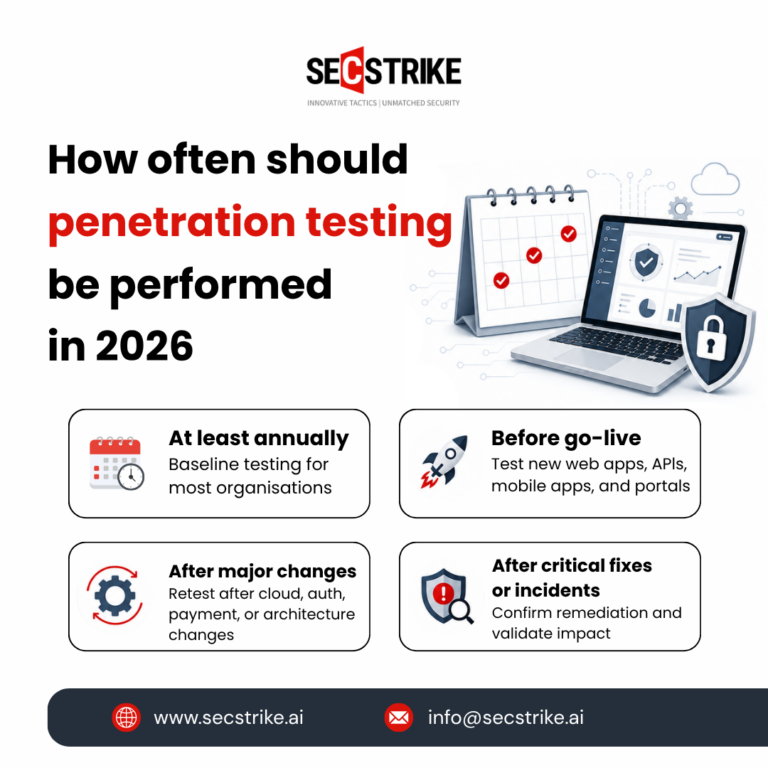
Most organisations should conduct a full penetration test at least once a year.
But you should also run a new test when there is a meaningful change to your systems, such as:
- Launching a new web application, mobile app, API, or customer portal
- Migrating infrastructure to cloud or changing cloud architecture
- Adding new authentication, payment, or user-role logic
- Releasing a major application update
- Connecting new third-party systems
- Changing firewall, segmentation, VPN, or exposed network services
- After a serious incident or suspected compromise
In 2026, the better question is not only “How often should we pentest?”
It is:
“What changes in our environment should trigger a new test?”
Recommended Pentest Cadence for 2026
1. Critical Systems: Every 6–12 Months
Systems that handle customer data, payments, authentication, internal admin access, or business-critical workflows should be tested more frequently.
For example:
- Internet-facing web applications
- APIs
- Mobile banking or fintech apps
- Customer portals
- Cloud infrastructure
- Systems connected to sensitive internal data
For these systems, an annual pentest should be treated as the minimum. A 6-month cadence is more appropriate when the system changes often or has high business impact.
2. Major Releases: Before Go-Live
Any major release should trigger security testing before launch.
This is especially important when the release includes:
- New login or MFA flow
- New API endpoints
- New user roles or permissions
- New payment flow
- New integration with third-party services
- New admin dashboard
- Major backend or cloud change
A system can work perfectly in functional testing and still fail security testing.
3. Vulnerability Assessment: Monthly or Quarterly
Penetration testing validates exploitability. Vulnerability Assessment helps maintain visibility between pentest cycles.
A practical 2026 approach is:
- Run VA regularly to identify known issues, misconfigurations, and exposed services
- Run pentest periodically to validate real attack paths
- Retest after remediation to confirm the issue is closed
VA tells you what might be vulnerable. Pentest shows what can actually be exploited.
4. After Remediation: Always Retest
Fixing a vulnerability is not the same as proving it is fixed.
Retesting helps confirm:
- The original vulnerability has been closed
- The fix did not create a new issue
- Compensating controls work as expected
- The risk can be formally marked as resolved
Without retesting, teams are often relying on assumption rather than evidence.
A Simple 2026 Rule of Thumb
Use this as a practical starting point:
Situation | Recommended Action |
Stable internal system | Annual pentest |
Internet-facing application | Every 6–12 months |
Critical app or API | Every 6 months or after major changes |
New app before launch | Pentest before go-live |
After major system change | Targeted retest or full pentest |
After critical vulnerability fix | Retest |
After incident or suspected breach | Compromise assessment + targeted testing |
A pentest should not be treated as an annual checkbox.
It should be part of a security rhythm: test, fix, retest, and repeat when the environment changes.
In 2026, attackers move faster, applications change faster, and AI-generated code is increasing the volume of systems being launched without enough security review.
The organisations that stay ahead are not the ones that test once and forget.
They are the ones that know when risk has changed — and test before attackers do.
Ready to build the right pentest cadence for your organisation?
Book a free scoping call with SecStrike to assess your web application, API, network, cloud, or critical system.