
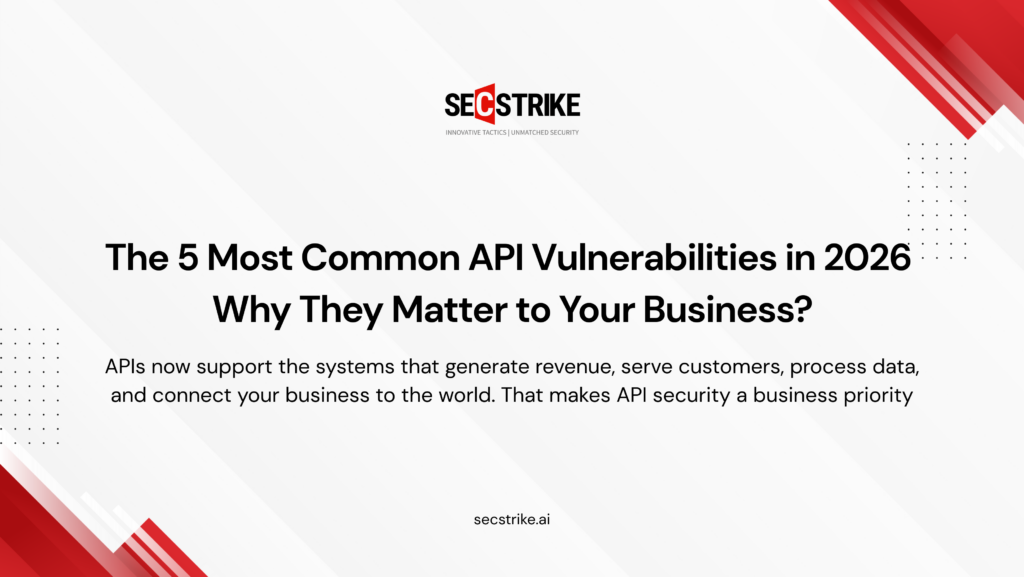
Introduction: APIs Are Now One of Your Biggest Business Attack Surfaces
APIs sit behind almost every digital experience your business delivers. They connect mobile apps, payment systems, customer portals, SaaS tools, partner platforms, and increasingly, AI-powered workflows.
That speed and connectivity create value. They also create risk. If an API is poorly secured, it can quietly expose customer data, enable fraud, disrupt services, or create compliance issues before anyone notices.
API stands for Application Programming Interface. Think of an API like a waiter in a restaurant: it takes your request to the kitchen and brings the response back. If that waiter does not check who ordered what, someone could steal your meal, change your order, or access something they should never see.
Here are the 5 most common API vulnerabilities in 2026 that business leaders, IT managers, and CTOs should understand.
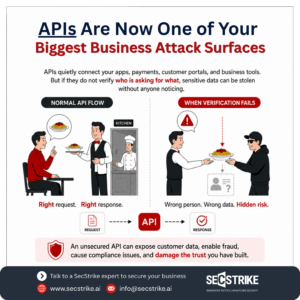
1. Broken Object Level Authorization (BOLA)
BOLA happens when an API allows one user to access another user’s data. For example, a customer should only be able to view invoice 1001, but by changing the ID in the API request to 1002, they can see someone else’s invoice.
This is dangerous because the attacker may already be logged in. The issue is not always “can they access the system?” but “can they access only what they are supposed to access?” For businesses, BOLA can lead directly to customer data exposure, privacy violations, compliance problems, and loss of trust. A strong API test should verify whether users can access records, orders, files, invoices, or account details that belong to someone else.
2. Broken Authentication
Authentication is how an API confirms that a user is who they claim to be. When authentication is weak, attackers may abuse stolen credentials, poorly protected tokens, long-lived sessions, or missing multi-factor authentication.
This type of weakness is especially risky because attackers can look like legitimate users. Once inside, they may access sensitive systems, take over accounts, trigger unauthorized transactions, or quietly collect data. Businesses should test whether tokens can be reused, sessions can be hijacked, login flows can be bypassed, or old credentials still create access.
3. Broken Object Property Level Authorization
This vulnerability happens when an API exposes or allows changes to data fields that should be protected. A normal user might be allowed to update their profile name or phone number, but the API should never let them change their role to “admin.”
The same issue can happen with data exposure. Your website may only show a customer’s name, but the API response may include national ID numbers, internal risk scores, account flags, or other hidden details. This creates serious business risk because sensitive data can leak without appearing on the screen. API testing should check whether responses reveal too much information and whether users can modify fields they should not control.
4. AI-Driven API Abuse
In 2026, API attacks are becoming faster and more automated. Attackers can use bots and AI-assisted tools to test endpoints, imitate normal users, and abuse business workflows at scale.
This is not always a classic “hack.” Sometimes the API works exactly as designed, but the workflow is abused. Examples include fake account creation, credential stuffing, coupon abuse, loyalty point manipulation, price scraping, payment abuse, or excessive API calls that increase cloud costs.
For businesses, the result can be fraud, revenue leakage, infrastructure cost spikes, poor customer experience, or service disruption. API security testing should look beyond technical flaws and ask whether the business process itself can be exploited through automation.
5. Shadow APIs
Shadow APIs are APIs that are live but not properly documented, monitored, owned, or tested. They often appear when teams move quickly and old systems are not fully retired.
Common examples include:
- Old API versions still running after a migration
- Temporary partner integrations that were never removed
- Test environments accidentally exposed online
- Internal APIs made accessible from the internet
- Forgotten endpoints with outdated security controls
Shadow APIs are risky because they sit outside normal visibility. Security teams may not scan them, developers may not maintain them, and auditors may not know they exist. Businesses should maintain a clear API inventory that identifies every API, version, environment, owner, and data type handled.
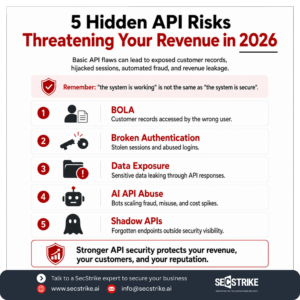
Why Businesses Cannot Ignore API Security
API vulnerabilities are not just technical problems. They affect customer trust, regulatory exposure, financial performance, and business continuity.
A vulnerable API can cause a data breach without taking your website offline. It can allow fraud without triggering an obvious system failure. It can expose sensitive information while the front-end application still appears to work normally.
That is why “the system is working” is not the same as “the system is secure.”
SecStrike helps organizations uncover these blind spots through offensive security services including API Penetration Testing, Web Application Penetration Testing, Vulnerability Assessment, and expert-reviewed security validation. SecStrike combines consultant-led expertise, platform-supported delivery, AI-assisted triage, and human validation to help businesses identify the weaknesses attackers are most likely to exploit first.
Conclusion: Find API Blind Spots Before Attackers Do
APIs now support the systems that generate revenue, serve customers, process data, and connect your business to the world. That makes API security a business priority.
The most dangerous API risks are often hidden in authorization rules, authentication flows, business logic, forgotten endpoints, and exposed data fields. They are difficult to spot with basic scanning alone.
Request Free Consultation with SecStrike’s offensive security experts to identify API blind spots, validate real business risk, and prioritize what to fix first.
Sources
- OWASP API Security Top 10: https://owasp.org/API-Security/
- OWASP API Security Top 10 2023: https://owasp.org/API-Security/editions/2023/en/0x11-t10/
- Salt Labs State of API Security Report: https://salt.security/press-releases/salt-labs-state-of-api-security-report-reveals-99-of-respondents-experienced-api-security-issues-in-past-12-months
- SecStrike Company Profile 2026
- SecStrike Thai Key Messaging Guide 2026